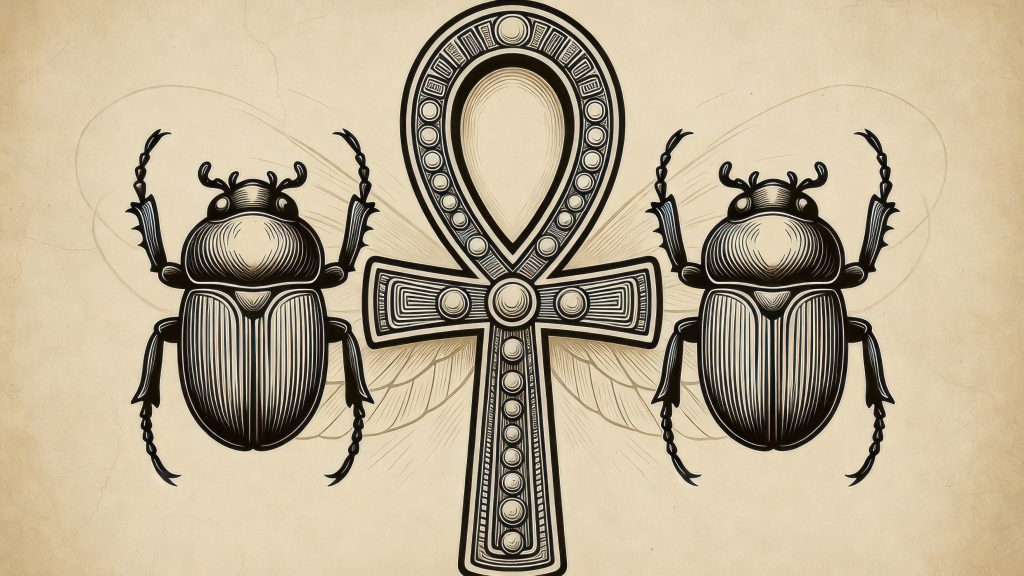
Hold an Ankh in your hand and you’re holding the same shape Egyptian gods used to grant eternal life to pharaohs. This cross with a loop at the top appeared in Egypt around 3150 BCE, during the Early Dynastic Period, and became one of the most enduring symbols in human history.
The Ankh was not just a religious icon though. It was the hieroglyph for “life” itself, written as Ꜥnḫ in ancient Egyptian script. When you see it carved into tomb walls or held by a deity in temple reliefs, you are looking at the Egyptian word for existence, breath, and continuation beyond death.
Gods are shown pressing the Ankh to the noses of pharaohs in countless temple scenes. The Egyptians believed this gesture transferred divine breath from the eternal realm into mortal kings, granting them life that would continue after their bodies died. The symbol represented everything the Egyptians valued most: vitality in this world, fertility to continue their lineage, and the promise of resurrection in the next life.
While many ancient symbols disappeared when their civilizations collapsed, the Ankh continued through different cultures and eras. Early Christians in Egypt adopted it as the crux ansata. Modern spiritual movements reclaimed it as a symbol of African heritage and mystical power. Tattoo artists ink it onto skin as a mark of eternal life and personal transformation. The Ankh endured because its core meaning—the possibility that life continues beyond death—remained meaningful across thousands of years.
The Ankh was one of over thirty symbols that shaped how ancient Egyptians understood existence, death, and the divine. Explore other Egyptian symbols and their meanings.
What the Ankh Actually Meant to Ancient Egyptians
The Ankh carried multiple layers of meaning that worked together in Egyptian religious thought. These weren’t contradictory interpretations but different facets of the same core concept: life force.
At its most basic level, the Ankh meant breath and vitality. The hieroglyph Ꜥnḫ appeared in phrases like “neb-ankh,” meaning “possessing life.” When scribes wrote about someone living, thriving, or continuing to exist, they used this symbol. It wasn’t abstract. It was as concrete as breathing.
The loop at the top represented the eternal, the part of existence that doesn’t end. The cross below connected to the physical world, the body walking through life. Together they showed earthly life linked to existence that continues after death. This is why gods hold it by the loop—they’re offering the eternal part, the piece that survives death.
Fertility was also woven into the symbol’s meaning. Some scholars interpret the loop as representing the female principle and the cross as the male, making the Ankh a union of opposites that creates new life. This wasn’t just about human reproduction. It was about the creative force that made the universe possible, the power that brought order out of chaos at the beginning of time.
As a protective amulet, the Ankh guarded both the living and the dead. People wore Ankh pendants daily, believing the symbol would keep them healthy and alive. When they died, Ankhs were buried with them—carved into coffin walls, placed as amulets on the body, painted on tomb ceilings. The symbol was insurance that death wouldn’t be final.
The Ankh frequently appeared in depictions of pharaohs and divine authority. In temple reliefs, gods are shown offering the Ankh to kings. The Egyptians used these images to communicate that pharaohs ruled by divine approval, not just by force. The symbol represented the theological justification for kingship rather than its military or political basis.
The famous mirror from Tutankhamun’s tomb has an Ankh-shaped handle, literally letting the young king hold life in his hands while he looked at his reflection.
How the Ankh Evolved Through Egyptian History
The Ankh appeared early in Egyptian history and its meaning deepened as Egyptian religion developed over three thousand years of continuous civilization.
During the Old Kingdom (2686-2181 BCE), the Ankh appears primarily in funerary contexts. Stone sarcophagi from this period show the symbol prominently, often paired with phrases about the deceased “possessing life” in the afterlife. The word “neb-ankh” became a standard epithet for those who had died but were believed to continue existing in the realm of Osiris.
The New Kingdom (1550-1077 BCE) brought an explosion of Ankh imagery in temple art. This was when Egypt reached its peak of power and wealth, building massive temple complexes covered in reliefs. In these scenes, gods don’t just hold the Ankh—they actively offer it to pharaohs, pressing it to royal noses and mouths. The gesture became a visual shorthand for divine approval and the transfer of eternal life from gods to kings.
The Amarna Period under Akhenaten (1353-1336 BCE) reimagined the Ankh in a striking way. When Akhenaten attempted to replace Egypt’s traditional gods with worship of the sun disk Aten, artists depicted the sun’s rays ending in tiny hands. Many of these hands hold Ankhs, offering them to the royal family below. The symbol adapted to fit radical religious change while keeping its core meaning: the sun gives life, and that life continues forever.
The Ptolemaic Period (305-30 BCE) saw Greeks ruling Egypt and Egyptian symbols beginning to merge with foreign religious ideas. The Ankh remained central to Egyptian religious practice, but its meaning started expanding beyond its original context. Greek-speaking Egyptians began explaining the symbol to outsiders, and these explanations didn’t always match traditional Egyptian theology.
When Christianity spread through Egypt in the early centuries CE, Coptic Christians didn’t abandon the Ankh. They transformed it into the crux ansata—the “handled cross”—and used it in their manuscripts and churches. The loop became the circle of Christ’s divinity, the cross his earthly suffering. The symbol survived by changing what it meant.
Where Did the Ankh Shape Actually Come From?
Egyptologists have proposed several theories about the Ankh’s physical origin. None can be proven definitively, but each offers insight into how the symbol might have developed its meaning.
The sandal strap theory suggests the Ankh represents the strap that wraps around the ankle of a sandal, viewed from above. Walking through life, leaving footprints in the sand—the connection seems obvious. But there’s limited evidence the Egyptians consciously made this association, even though sandals were common and symbolically important.
The Isis knot or “tyet” theory connects the Ankh to the “knot of Isis,” a symbol associated with the goddess’s protective magic. Both symbols share a similar loop-and-tail design. The tyet represented the goddess’s power to bind and protect, particularly in matters of fertility and childbirth. If the Ankh evolved from this earlier symbol, it would explain the fertility associations.
The mirror handle theory has strong archaeological support. Ancient Egyptian mirrors had reflective copper or bronze disks mounted on handles, and many surviving examples have Ankh-shaped handles. Mirrors were associated with the soul—looking at your reflection meant seeing your ka, your spiritual double. Holding life while seeing your soul made symbolic sense.
The spinal column theory links the Ankh to Osiris’s resurrection. After Set murdered and dismembered Osiris, Isis reassembled his body. The Ankh might represent Osiris’s spine—the structural support that let him stand and live again. This connects the symbol to the Djed pillar, another spinal symbol, and explains why Osiris is so often shown holding an Ankh.
The astronomical theory interprets the loop as the sun disk and the cross as the horizon where the sun rises. Each dawn, the sun brings life back to the world after the death of night. This reading fits with Egyptian creation myths where the first sunrise marked the beginning of ordered existence.
These theories aren’t mutually exclusive. The Ankh likely accumulated meanings over time, with different groups emphasizing different aspects. A symbol used for three thousand years doesn’t stay simple, or can’t, we should say.
Egyptian Deities Associated with the Ankh
The Ankh doesn’t appear with all Egyptian gods in the same way. Which deities are shown holding it reveals their specific roles in Egyptian religious thought.
Isis holds the Ankh more than almost any other deity. As the goddess of motherhood, magic, and resurrection, she embodied the life-giving and life-preserving powers the symbol represented. In the Osiris myth, she brings her murdered husband back to life long enough to conceive their son Horus. That act of resurrection made her the ultimate source of continuing life, so the Ankh in her hands made perfect sense to Egyptians.
Osiris carries the Ankh despite being the god of the dead. This seems contradictory until you come to understand that Egyptian “death” wasn’t about an ending—it was transformation into a different kind of existence. Osiris ruled the afterlife as a living king, not a corpse. The dead who passed judgment became “living spirits” in his realm. The Ankh in his hands promised that death leads to another form of life.
Ra, the sun god, holds the Ankh as the creator deity who brought the universe into being. Each sunrise reenacted that first moment of creation when light pushed back chaos and made life possible. When Ra offers the Ankh to other gods or to pharaohs, he’s sharing the generative power that created everything.
Hathor, goddess of love, music, and joy, carries the Ankh as the provider of life’s pleasures. Her version of life wasn’t just survival—it was thriving, celebrating, experiencing beauty and pleasure. The Ankh in her hands meant life worth living, not just existence.
In temple scenes, the standard depiction shows a deity pressing the Ankh to a pharaoh’s nose. This wasn’t symbolic in the abstract sense. The Egyptians believed this gesture transferred divine life force from the god into the pharaoh’s body, ensuring the king would continue to exist after physical death.
The Ankh in Modern Spirituality and Culture
The Ankh didn’t stay in ancient Egypt. It traveled through time by adapting to new contexts and new meanings.
Coptic Christianity transformed the Ankh into the crux ansata in the 3rd and 4th centuries CE. Early Christian manuscripts from Egypt show the symbol prominently, sometimes replacing the traditional Christian cross entirely. The loop became Christ’s halo, the divine nature. The cross remained the instrument of crucifixion and salvation. The symbol promised eternal life through Christ instead of eternal life through Osiris, but the visual form stayed the same.
The Afrocentric movement of the 20th century reclaimed the Ankh as a symbol of African spiritual heritage. During the 1960s and 70s, as Black Americans sought connections to pre-colonial African culture, the Ankh became a powerful emblem. It represented a sophisticated civilization that thrived before European contact, a spiritual tradition that valued life and continuity. Wearing an Ankh became a political and cultural statement.
Goth subculture adopted the Ankh in the 1980s and 90s, partly through vampire fiction and occult aesthetics. The symbol appeared in movies, music videos, and fashion as a mark of mystical knowledge and fascination with death and immortality. This use often stripped away the symbol’s Egyptian theological context, but it kept the core idea: death isn’t the end, and there’s power in symbols that bridge the mortal and eternal.
Modern tattoo culture treats the Ankh as one of the most popular ancient symbols. People get Ankh tattoos for various reasons—honoring Egyptian heritage, marking spiritual awakening, symbolizing protection, celebrating life after surviving serious illness. Modern interpretations are typically personal rather than based on Egyptian theology, though many people still associate the symbol with concepts of continuation, protection, or spiritual transformation.
Common Questions About the Ankh Symbol
What does the Ankh symbolize?
The Ankh symbolizes life, breath, and eternal existence in ancient Egyptian religion. It served as the hieroglyph for “life” and represented the continuation of existence beyond physical death. Gods held it by the loop to offer divine breath to pharaohs, transferring immortality from the eternal realm to mortal kings. The symbol also carried meanings of fertility, protection, and the creative force that brought the universe into being.
Is the Ankh a Christian symbol?
The Ankh originated as an ancient Egyptian pagan symbol thousands of years before Christianity existed. However, Coptic Christians in Egypt adopted it as the crux ansata (handled cross) in the 3rd-4th centuries CE. They reinterpreted the loop as Christ’s divine nature and the cross as his earthly crucifixion. So while the Ankh isn’t originally Christian, it was incorporated into early Egyptian Christianity and given new theological meaning.
What does an Ankh tattoo mean?
Ankh tattoos typically symbolize eternal life, spiritual awakening, protection, or connection to African heritage. Many people get Ankh tattoos after surviving serious illness or major life transitions, representing their continued existence and transformation. Others choose it to honor Egyptian ancestry or express interest in ancient spiritual traditions. The meaning is often personal rather than strictly following ancient Egyptian theology, but the core concept of life continuing beyond apparent endings remains central.
Which Egyptian gods hold the Ankh?
Isis, Osiris, and Ra are the Egyptian gods most frequently shown holding the Ankh. Isis carries it as the goddess of resurrection and motherhood who brought Osiris back to life. Osiris holds it as ruler of the afterlife, promising continued existence to the dead. Ra carries it as the creator sun god who brought life into being. Hathor, Anubis, and other deities also appear with the Ankh, but less commonly. The symbol indicated which gods had power over life, death, and continuation.
Why do some people wear the Ankh upside down?
An inverted Ankh is sometimes used in modern occult and spiritual practices to represent feminine or lunar energy, as opposed to the upright Ankh representing masculine or solar energy. This interpretation isn’t based on ancient Egyptian usage—Egyptians didn’t invert the Ankh for symbolic purposes. The practice emerged in 20th-century Western occultism as practitioners developed new symbolic systems drawing loosely from Egyptian imagery. In ancient Egypt, the Ankh was always shown upright when held by gods or used in hieroglyphic writing.